


The Micro-Trauma Cycle: Why Your Skin Never Heals From Daily Shaving

📌 Key Takeaways
Daily shaving traps your skin in a damage-repair loop that never fully heals—breaking the cycle requires either more rest time or removing the need to shave.
It's Not Sensitive Skin: That constant irritation follows a predictable pattern because you're re-injuring skin before it finishes healing.
Shaving Reopens Tiny Wounds: Each razor pass scrapes away protective cells, and shaving again the next day removes partially healed tissue.
Bumps Form From Trapped Hair: Inflamed, thickened skin makes it harder for regrowing hair to break through, causing it to curl back inward.
Fewer Shaves Help Most: Switching to every other day lets your skin complete its repair cycle and often reduces irritation within weeks.
Laser Removes the Trigger: Permanent hair reduction eliminates the need to shave, allowing the skin barrier to finally exit defense mode.
Stop reopening the wound, and your skin can finally heal.
Anyone frustrated by persistent razor bumps, ingrown hairs, or irritation that never settles will find relief strategies here, preparing them for the detailed guidance that follows.
~ ~ ~ ~ ~ ~ ~ ~ ~ ~ ~ ~ ~ ~ ~ ~ ~ ~ ~ ~ ~ ~ ~ ~ ~ ~ ~ ~ ~ ~ ~ ~ ~ ~ ~ ~ ~ ~ ~ ~ ~ ~ ~ ~ ~ ~ ~ ~ ~ ~ ~ ~ ~ ~
The mirror doesn't lie.
You're staring at another crop of red bumps along your jawline. The razor was new. The shave cream was expensive. You did everything "right"—and your skin still looks angry.
Maybe it's just my sensitive skin.
That thought has probably crossed your mind a hundred times. You've switched razors, tried different creams, experimented with shaving techniques. Nothing sticks. The irritation always comes back, sometimes worse than before.
Here's the reality: the problem likely isn't your products, technique, or skin type. The problem is the pattern itself.
If shaving feels like it never "settles down," it's because each shave creates tiny, repeated injuries (micro-trauma) that trigger inflammation. When you shave again before the skin fully recovers, you restart the inflammation loop—so the barrier stays stuck in repair mode, and bumps and ingrowns become the "new normal."
The Myth: "My Skin Is Just Sensitive"
You've heard this explanation before. Maybe you've even accepted it as fact: some people simply have sensitive skin, and there's not much you can do about it.
This belief is comforting because it removes responsibility. If your skin is inherently fragile, the constant irritation isn't your fault—and it's not fixable either. You just have to manage it.
But this explanation has a problem. It doesn't account for why the irritation follows such a predictable pattern. Why does your skin feel raw in the same spots, flare up at the same intervals, and respond to the same triggers over and over again?
True sensitive skin—like rosacea or eczema—often flares unpredictably. Mechanical injury, however, behaves like clockwork.
What if those bumps and that persistent rawness aren't signs of genetic bad luck? What if they're signs that your skin is trying—and failing—to heal from something you're doing to it every single day?
The alternative explanation is simpler and more useful: your skin isn't overly sensitive. It's under constant assault. And the assault has a name.
What "Micro-Trauma" Actually Means (In Plain Language)
Every time a razor blade crosses your skin, it does more than cut hair. It scrapes the outermost layer of your skin—the part that acts as your body's first line of defense against bacteria, irritants, and moisture loss.
This outer layer, the stratum corneum, is your biological shield. When healthy, it creates a seamless seal against bacteria, irritants, and moisture loss. When damaged, your skin feels tight, dry, and reactive.
A single shave creates tiny, often invisible cuts and abrasions. On their own, these micro-injuries aren't a big deal. Your skin is designed to repair minor damage. Given a few days of rest, the barrier rebuilds itself, and everything returns to normal.
The trouble starts when you don't give it those few days.
When you shave again the next morning—or even the same evening—you're scraping away skin that was still in the middle of repairing itself. You're removing the new cells before they've had a chance to settle. You're reopening a wound that was trying to close.
This is what micro-trauma means: small injuries that wouldn't matter on their own, but become a serious problem when they happen faster than your body can fix them.
Think of it like picking at a scab. One time won't cause permanent damage. But if you pick at the same spot every day, it never heals. Eventually, the skin in that area becomes chronically inflamed, discolored, or scarred.
Daily shaving does something similar—just on a microscopic scale.
The Micro-Trauma Cycle: How Daily Shaving Traps Your Skin in Repair Mode
The pattern of damage and incomplete healing isn't random. It follows a predictable loop that escalates over time.
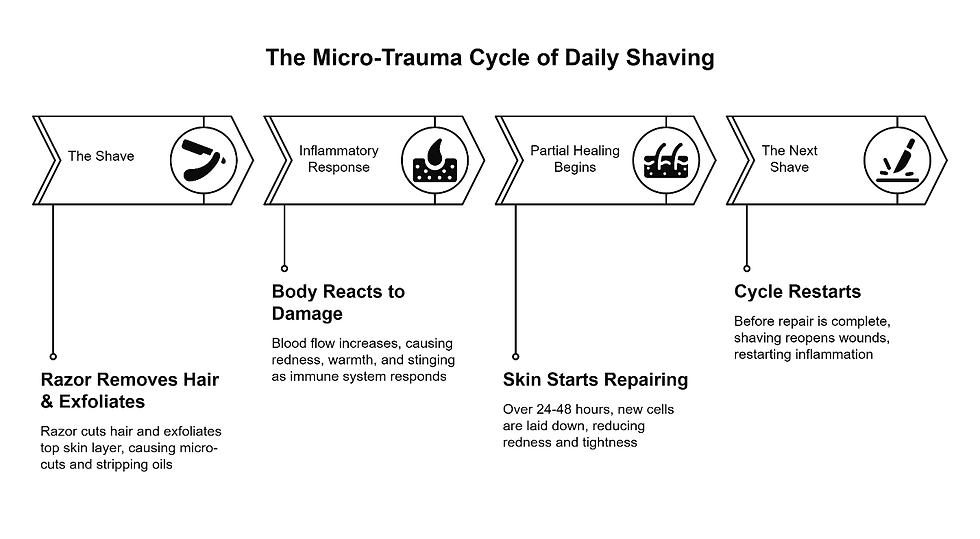
Stage 1: The Shave
The razor removes hair and exfoliates the top layer of skin. Micro-cuts form along the surface. Natural oils that protect the barrier are stripped away.
Stage 2: The Inflammatory Response
Your body recognizes the damage and sends blood flow to the area. Redness appears. The skin may feel warm, tight, or stinging. This inflammation is actually your immune system trying to help—it's the first step of healing.
Stage 3: Partial Healing Begins
Over the next 24 to 48 hours, your skin starts laying down new cells to repair the barrier. This process requires time and resources. The redness begins to fade. The tightness eases slightly.
Stage 4: The Next Shave (Cycle Restarts)
Before the repair is complete, you shave again. The fresh blade scrapes away the partially healed tissue. The inflammatory response restarts from scratch. The barrier never fully closes.
If you reopen the "wound" daily, your skin never exits repair mode. It stays stuck in a state of chronic, low-grade inflammation—which is the perfect setup for bumps, ingrown hairs, and breakouts.
This is why changing razors rarely fixes the problem. A sharper blade might create cleaner cuts, but it doesn't change the fundamental math: if trauma exceeds healing speed, the skin never fully recovers.
How Micro-Trauma Turns Into Bumps, Ingrowns, and "Acne"
Chronic inflammation doesn't just make your skin feel raw. It changes how your hair follicles behave—and that's where the visible problems start.

The Bump Problem
When your skin barrier is compromised, it becomes more reactive. Minor irritants that wouldn't normally cause a reaction—sweat, friction from a collar, traces of product residue—can now trigger a disproportionate response. The result is small, raised bumps that appear within hours of shaving and may persist for days.
These bumps aren't acne in the traditional sense. They're inflammatory papules caused by barrier disruption and follicle irritation. But they look similar enough that many people treat them with acne products, which can actually make the problem worse by further irritating already-damaged skin.
The Ingrown Hair Trap
Here's where the cycle gets particularly vicious.
When you shave, you cut the hair at a sharp angle. As it regrows, that sharp tip can curve back toward the skin instead of growing straight out. If the skin above the follicle is inflamed or thickened—which happens with chronic micro-trauma—the hair has an even harder time breaking through. It curls back into the skin, where your body treats it as a foreign invader.
The result is a painful, raised bump that may fill with fluid or pus. This condition is called pseudofolliculitis barbae, though most people just call it razor bumps or ingrown hairs.
Pseudofolliculitis is especially common in people with curly or coarse hair, because curved follicles make it easier for the hair tip to re-enter the skin. This pattern shows up in predictable zones: the neckline and collar area, underarms, bikini line, and lower legs. The American Academy of Dermatology notes that anyone who shaves frequently can develop these bumps—the chronic inflammation from micro-trauma creates the conditions that allow ingrowns to flourish.
The Folliculitis Factor
Sometimes, the damage goes deeper than simple ingrown hairs.
When the skin barrier is repeatedly compromised, bacteria that normally live harmlessly on your skin can enter the hair follicles and cause infection. This leads to folliculitis—inflamed, often pus-filled bumps that may be tender or itchy.
Folliculitis can look a lot like acne, which is why so many people misdiagnose their shaving-related skin issues. The treatment approaches are different, though. Acne products target oil production and pore blockage. Folliculitis requires addressing the underlying bacterial issue and—critically—reducing the trauma that's allowing bacteria to enter in the first place.
How to Interrupt the Cycle: Short-Term and Long-Term Strategies
Understanding the micro-trauma cycle is the first step. The second step is figuring out how to break it.
Short-Term: Give Your Skin a Chance to Catch Up
The most effective short-term intervention is also the simplest: shave less often.
Every additional day between shaves gives your skin more time to complete its repair cycle. For many people, switching from daily shaving to every other day—or even every third day—produces noticeable improvement within a few weeks.
If you can't reduce frequency due to work or personal requirements, consider these adjustments:
Shave with the grain, not against it. Going against the direction of hair growth produces a closer shave, but it also increases the risk of cutting hair below the skin surface, which leads to more ingrowns. This is especially important in high-irritation zones like the neckline and collar area.
Use a single-blade razor. Multi-blade razors are designed to lift and cut hair multiple times per stroke. This creates a closer shave, but it also multiplies the micro-trauma.
Skip the second pass. Reapplying the blade to areas you've already shaved removes skin that's already lost its protective oil layer. The result is deeper cuts and more inflammation.
Support barrier repair after shaving. Look for post-shave products that focus on calming and hydrating rather than those containing alcohol, which strips moisture and can worsen irritation. Ingredients like aloe vera, niacinamide, or ceramides help the barrier rebuild faster.
These adjustments can reduce symptoms, but they don't eliminate the fundamental problem. As long as you're shaving regularly, you're creating micro-trauma. The question is whether you can reduce it enough to let healing outpace damage.
Long-Term: Addressing the Root Cause
For some people, optimizing shave technique is enough to manage symptoms. For others—especially those with curly hair, sensitive skin, or jobs that require daily shaving—the math never quite works out. Trauma keeps outpacing healing, and the cycle continues.
In these cases, the most effective long-term solution is to reduce or eliminate the need for shaving altogether.
Permanent hair reduction—through methods like laser hair removal—works by targeting melanin in the follicle to inhibit future growth. It alters the fundamental equation: no hair means no shave, which means no trauma. With the mechanical agitator removed, the skin barrier exits "defense mode" and finally heals.
This isn't about aesthetics or vanity. It's about breaking a mechanical cycle that's keeping your skin in a constant state of damage. Dermatologists use laser hair reduction clinically for patients with chronic razor bump patterns, and research published in JAMA Dermatology supports its effectiveness for pseudofolliculitis barbae.
Modern laser technology has advanced significantly in recent years. The FDA clears these devices for specific uses, such as permanent hair reduction. However, safety depends heavily on the operator's training; seeking treatment in a medically supervised setting ensures that these powerful tools are used according to rigorous clinical protocols. Most areas require multiple sessions spaced several weeks apart to achieve what the FDA defines as "permanent hair reduction"—a long-term, stable decrease in the number of regrowing hairs.
A razor manages the symptom. Laser eliminates the trigger.
When to Get Professional Help
Most shaving-related skin issues can be managed with the strategies above. But some situations warrant a conversation with a dermatologist or skin care professional.
Signs That Something More Serious May Be Happening
Bumps that don't resolve within a week or two of not shaving. Persistent lesions may indicate deeper infection or a condition that requires treatment beyond lifestyle changes.
Pus-filled bumps that are warm to the touch or spreading. This could indicate bacterial folliculitis that needs topical or oral antibiotics.
Spreading redness, warmth, or fever. These symptoms suggest infection may be moving beyond the follicle and requires prompt medical attention.
Dark patches or discoloration that persist after bumps heal. Post-inflammatory hyperpigmentation is common, especially in darker skin tones, and may benefit from targeted treatment.
Raised, firm scars forming over previously irritated areas. Keloid scarring can develop from chronic inflammation, particularly in the beard area. Early intervention can prevent progression.
Cysts or deep, painful lumps beneath the skin surface. These may require drainage or other medical intervention.
If you've been dealing with chronic irritation for months or years and nothing seems to help, it's worth getting a professional assessment. What feels like "sensitive skin" may actually be a treatable condition with a specific name and a specific solution.
Breaking Free From the Daily Damage Loop
The morning mirror check doesn't have to be a source of dread.
Understanding why your skin struggles to heal—that it's not a personal flaw but a predictable consequence of repeated micro-injury—is the first step toward something better. Your skin isn't broken. It's responding exactly the way skin responds to trauma that never stops.
The cycle can be interrupted. Short-term, that means giving your barrier time to recover between shaves. Long-term, it may mean reducing or eliminating the need for shaving altogether.
Either way, the path forward starts with recognizing what's actually happening beneath the surface—and choosing to stop reopening the wound.
If you're tired of the daily irritation loop, a consultation can help you understand what's driving your bumps and what would realistically break the cycle for your skin. Avere Beauty offers free consultations at locations in Pittsburgh's Lawrenceville neighborhood and Murrysville, where the focus is on finding solutions that fit your life—not just selling treatments. You can see what to expect from your visit or schedule a consultation directly.
This guide is intended as a comprehensive starting point. For decisions specific to your unique situation, we always recommend consulting a qualified professional.
Our Editorial Process
Our expert team uses AI tools to help organize and structure our initial drafts. Every piece is then extensively rewritten, fact-checked, and enriched with first-hand insights and experiences by expert humans on our Insights Team to ensure accuracy and clarity.
About the Avere Beauty Insights Team
The Avere Beauty Insights Team is our dedicated engine for synthesizing complex topics into clear, helpful guides. While our content is thoroughly reviewed for clarity and accuracy, it is for informational purposes and should not replace professional advice.


Comments