


Laser vs. Treatment Protocols: Which Approach is Right for Your Skin?

📌 Key Takeaways
Razor bumps and ingrown hairs aren't a willpower problem—they're a hair-versus-healing-speed problem that requires the right tool for your specific situation.
Name Your Problem First: Stubble frustration needs laser hair reduction; active painful bumps need skin repair first—different starting points lead to better results.
Surface Fixes Often Miss the Mark: Exfoliation and creams only help shallow issues; deep trapped hairs need laser energy that reaches the follicle itself.
Both Problems? Use Both Levers: When you have stubble and active bumps, calm the skin first, then reduce hair growth to stop the cycle from restarting.
Modern Lasers Changed the Game: Cooling technology makes sessions far more comfortable than older machines, and newer equipment works across many skin tones and sensitivities.
Multiple Sessions Are Normal: Hair grows in cycles, so 6–12 treatments catch follicles at different stages—expect gradual, permanent hair reduction over time.
Smooth, calm skin replaces frustrating routines when you match the solution to your actual problem.
People tired of daily shaving battles and recurring bumps will find a clear decision framework here, preparing them for the detailed treatment options that follow.
~ ~ ~ ~ ~ ~ ~ ~ ~ ~ ~ ~ ~ ~ ~ ~ ~ ~ ~ ~ ~ ~ ~ ~ ~ ~ ~ ~ ~ ~ ~ ~ ~ ~ ~ ~ ~ ~ ~ ~ ~ ~ ~ ~ ~ ~ ~ ~ ~ ~ ~ ~ ~ ~
The bathroom light is unforgiving. You lean closer to the mirror, and there they are again—red bumps scattered across your neck, the sting from last night's shave still simmering beneath the surface. Another day, another battle. Applying deodorant over freshly irritated skin sends a sharp reminder that this routine isn't working.
If you're deciding between laser and a treatment protocol, start by naming today's problem: is it mainly the hair (constant stubble and shaving trauma), or mainly the skin (active razor bumps, trapped hairs, or inflamed follicles)? Laser hair removal reduces hair growth so you're not repeatedly injuring the same skin with daily shaving. Treatment protocols are a structured skin-first plan—calm inflammation, clear what's trapped, and prevent the next flare—often including laser as the long-term prevention tool. Many people ultimately do both; the right starting point depends on how irritated your skin is right now.
It transitions your morning from a source of frustration into a predictable, irritation-free routine.
Quick Answer: Which Path Fits Your Skin Today?
Before diving into the details, here's a snapshot to help you find your starting point:
Your Main Problem Today | What That Usually Means | Best Starting Path | What Improvement Feels Like | What to Do Next |
Constant stubble + daily irritation, but bumps are mild | Shaving trauma is the primary issue | Hair Reduction (Laser) | Longer stretches between shaves; skin stays calm | |
Frequent red bumps and ingrowns that keep returning | Chronic inflammation from curled-back hairs | Skin Repair Protocol first, then Hair Reduction | Fewer flare-ups; existing bumps fade | Schedule a consultation |
Deep, painful, or cyst-like bumps | Trapped hairs too deep for surface treatments | Skin Repair Protocol (consider medical evaluation) | Relief from tender spots; reduced scarring risk | |
A mix of stubble frustration AND active bumps | Both the hair and the skin need attention | Combined Plan | Calmer skin plus long-term hair reduction | Consultation to build a custom plan |
Most people don't need to choose one path forever. Many succeed by starting with skin calming when bumps are active, then switching to hair reduction to prevent the next cycle from starting.
What We Mean by "Laser Hair Removal" vs. "Treatment Protocols"

These terms get tossed around often, so let's clarify what each actually does.
Laser hair removal uses concentrated light to penetrate hair follicles and inhibit future growth. Think of it as turning off the power switch to the hair root, rather than just trimming the wire. Technologies like the Motus AZ+ deliver this energy with minimal discomfort, making sessions feel manageable even on sensitive areas. Medical lasers are regulated devices with established safety frameworks—the FDA maintains regulatory information and guidance for these systems. The goal is permanent hair reduction: fewer hairs growing back means less shaving, which means less trauma to your skin.
Treatment protocols take a skin-first approach. They're a structured plan to calm existing inflammation, address trapped hairs, and prevent recurrence. Often, laser is part of this plan—but it's sequenced with skin-support steps so you're not treating a wound while creating new ones. Visualize the redness and bumps fading away to reveal healthy, clear skin underneath.
The difference matters because starting with the wrong approach can waste time or make things worse. Blasting a laser at actively inflamed, cyst-filled skin isn't ideal. Neither is waiting to address hair growth while bumps keep multiplying.
Start With Symptoms: Stubble, Bumps, or Both?
Let's map what you're seeing to what's actually happening beneath the surface.
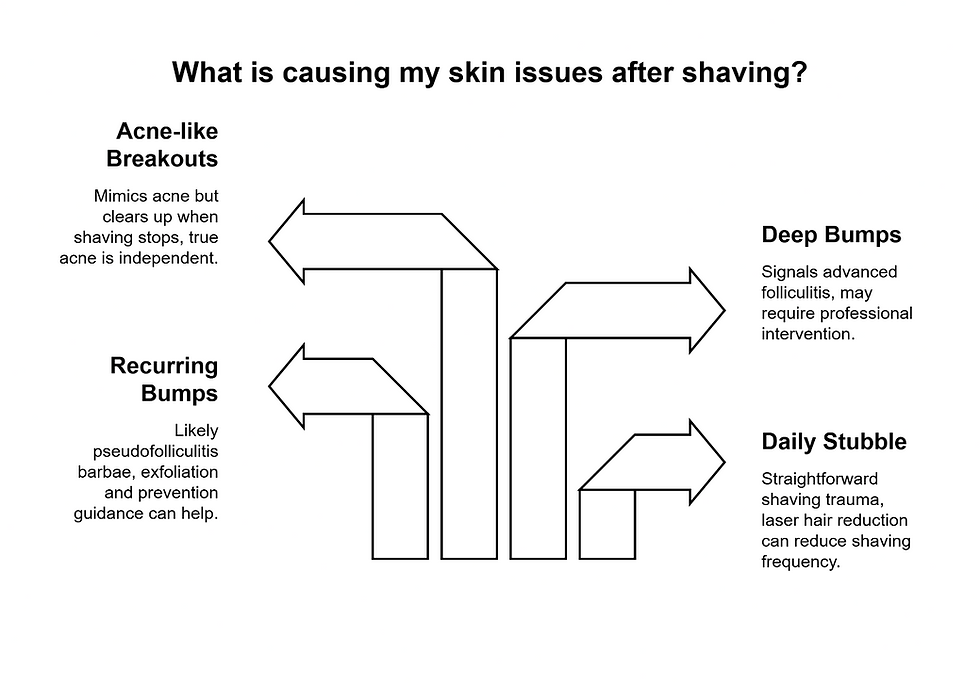
Pattern 1: Daily stubble + mild irritation, no significant bumps
This is straightforward shaving trauma. Your skin gets roughed up by the blade daily, but the hair isn't curling back and trapping itself. Laser hair reduction directly addresses this by reducing how often you need to shave—or eliminating shaving entirely for certain areas.
Pattern 2: Recurring red bumps in predictable spots
You're likely dealing with pseudofolliculitis barbae, commonly known as razor bumps. When shaved hair curls back and re-enters the skin, it triggers an inflammatory response. This condition is particularly common in people with curly or coarse hair. Surface exfoliation helps some people, but many find bumps return within days of shaving. The American Academy of Dermatology offers prevention guidance that can help reduce flare-ups.
Pattern 3: Deep, tender, or cyst-like bumps
This signals a more advanced form of folliculitis—inflamed hair follicles that may involve trapped hair too deep for topical treatments to reach. Deep ingrown hairs can form painful cyst-like bumps, and complications may include infection, discoloration, and scarring—especially when irritated or picked. The Mayo Clinic notes that folliculitis can range from mild to severe, and deep infections may require professional intervention. If you're seeing pus, spreading redness, symptoms that don't improve after one to two weeks of self-care, or feeling feverish, pause here and consult a medical provider.
Pattern 4: "Acne-like" breakouts that appeared after shaving
Sometimes razor trauma mimics acne—small pustules scattered where the blade traveled. The difference? These clear up when you stop shaving and return when you start again. True acne behaves independently of your shaving schedule.
That distinction between razor burn (surface irritation that fades quickly) and ingrown-driven bumps (persistent, recurring inflammation) determines your path forward.
The Decision Framework: Two Levers, One Goal
Your skin has two problems competing for attention.
Lever 1: The Trigger. Hair growth forces you to shave repeatedly. Every pass of the blade creates micro-trauma. For some people, that trauma heals quickly. For others, it accumulates into chronic irritation and ingrowns.
Lever 2: The Reaction. Your skin's inflammatory response to trapped hairs, repeated cuts, and irritation. Once this cycle starts, it can become self-perpetuating—bumps form, you nick them while shaving, they get worse, repeat.
The guided choice:
If your goal is fewer hairs and less shaving trauma, start with laser hair reduction. This removes the trigger. Your skin won't heal if you're re-injuring it every morning.
If you have active, deep, or painful ingrowns—or signs of infection or significant inflammation—start with a protocol-focused plan. Hair reduction is still part of the long game, but your skin needs breathing room first.
If you have both? Use a combined approach. Calm the skin first, then reduce the trigger.
Why Surface-Only Routines Often Backfire
Here's where most advice falls short. The standard recommendation for razor bumps is exfoliation and salicylic acid. That works for surface-level issues—dead skin cells trapping hairs near the top.
But when hair is trapped deep (think painful, cyst-like bumps that last for weeks), exfoliation only irritates the surface while the real problem continues underneath. The hair is too deep for topical agents to reach. Ingrown hairs are fundamentally a geometry problem—curly or angled hair curling back and re-entering skin—not a discipline problem or a sign you're doing something wrong.
This is the mechanism-of-failure that keeps people stuck: they try creams, fancy razors, expensive scrubs—and nothing changes. Laser energy penetrates to the depth of the follicle to address the trapped hair from within. It's not adding more trauma to the surface; it's targeting the root cause directly. This is why exfoliation works for some people and does nothing for others—the depth of the problem determines which tool actually helps.
Self-Assessment Quiz: Hair Reduction, Skin Repair, or Combined?
Answer these nine questions honestly. Add up your points at the end.
1. How often do you shave the problem area?
Daily or near-daily → +2 Hair
A few times a week → +1 Hair
Rarely → +0
2. What's more annoying right now?
Stubble returning fast → +2 Hair
Red bumps lasting days → +2 Skin
Both equally → +1 Hair, +1 Skin
3. When bumps show up, are they mostly...
Small and surface-level → +1 Skin
Deep, tender, or cyst-like → +3 Skin
Mostly just redness, no bumps → +0
4. How often do you get repeat ingrowns in the same spots?
Most weeks → +2 Skin
Some months → +1 Skin
Almost never → +0
5. Do you see discoloration (dark spots) after bumps heal?
Often → +1 Skin
Sometimes → +0.5 Skin
Rarely → +0
6. If you stop shaving for a week, what happens?
Skin calms down noticeably → +2 Skin
Skin looks similar but hair is unbearable → +2 Hair
Hard to tell → +1 Hair, +1 Skin
7. What's your biggest fear about laser? (We'll address these—just note your answer.)
Pain
Safety for sensitive skin
"It won't work for me"
8. Are you dealing with open sores, pus, fever, spreading redness, or severe swelling?
Yes → Stop here. Seek medical evaluation before any cosmetic treatment.
No → Continue
9. What result do you want most?
Less maintenance and fewer hairs long-term → +2 Hair
Clearer skin and fewer flare-ups → +2 Skin
Both → +1 Hair, +1 Skin
Scoring Your Results
Hair-first path: Hair score ≥ 8 and Skin score ≤ 4. Your main battle is with the shaving cycle itself. Laser hair reduction addresses this directly by reducing how much hair grows back.
Skin-first path: Skin score ≥ 8 and Hair score ≤ 4. Your skin needs attention before prevention can work. A treatment protocol calms inflammation and clears trapped hairs, then laser prevents future cycles.
Combined path: Both scores ≥ 6, or everything else. You need both levers pulled. Start with skin calming to create a better baseline, then add hair reduction to keep it that way.
Regarding those fears from question seven: Modern lasers like the Motus AZ+ use cooling technology that makes sessions far more comfortable than older machines. They're designed to work across a wide range of skin tones and sensitivities. And "it won't work" is often a misconception from outdated equipment—newer technology has dramatically improved effectiveness.
What Results Actually Feel Like
Real comfort comes from real people who've been where you are:
"I have been seeing Diana for my Botox, lip injections and laser hair removal for the last year. She is amazing! She is extremely knowledgeable and answers all of my questions. I trust her with every service I've gotten." — Alexandra P (Google Reviews)
"I have been getting laser treatment with Angel for the past few months and I couldn't be more pleased! She has made the whole experience extremely comfortable for me as a first time client." — Camryn (Yelp)
The recurring themes? Comfort during treatment. Questions answered honestly. Trust earned through transparency. This is the "peace treaty" feeling— a significant reduction in daily skin sensitivity and a streamlined morning schedule.
Common Myths That Keep People Stuck
Myth: Exfoliation alone fixes deep ingrowns.
Surface exfoliation primarily treats the topmost layer of skin and can't effectively reach hair trapped deep within the dermis. When ingrowns become cystic, topical treatments address symptoms while the cause persists. That's why the same bumps return in the same spots—the trapped hair is still there. Razor bumps have a real biological mechanism; they're not a reflection of your effort or discipline.
Myth: Laser is only for women.
Laser hair removal for men is increasingly common, whether for aesthetic preferences, athletic performance, or—most relevant here—eliminating the razor bump cycle entirely. Avere Beauty serves clients of all genders seeking medical-grade solutions for sensitive skin. This isn't about vanity; it's about skin health.
Myth: Laser is too painful for sensitive areas.
Older lasers earned their painful reputation. Current technology uses cool-touch tips and advanced delivery systems that make treatments far more comfortable. Most people describe it as a quick snap, not ongoing discomfort.
Myth: It's permanent after one session.
Hair grows in cycles, and laser targets hair in the active growth phase. Multiple sessions (typically 6-12, generally spaced 4-6 weeks apart for the face and 6-10 weeks apart for the body) are needed to catch hair at different stages. The result is permanent hair reduction—significantly fewer hairs regrowing over time.
Next Steps
You've read through the framework, taken the quiz, and have a sense of your starting path. Here's what makes sense from here:
If you scored Hair-first: Review the laser hair removal page to understand what sessions feel like, how the technology works, and what results to expect over time.
If you scored Skin-first or Combined: A consultation maps your clinical presentation - skin type, bump severity, hair texture—to a plan that actually fits. No two people's skin is identical.
If you want a personalized plan built around your skin and hair type: Schedule a consultation with the team at Avere Beauty in Pittsburgh (3453 Butler Street, Lawrenceville; 412-952-7592). They'll assess where you are, answer questions honestly, and recommend a starting point that makes sense for your goals.
One Last Thing
If you've been blaming yourself for not finding the right routine, take that weight off your shoulders. Razor bumps and ingrowns aren't a willpower failure—they're what happens when hair behavior and shaving trauma exceed your skin's healing speed.
The morning routine doesn't have to be a battle. Smooth, calm skin is achievable—not through one more cream or another expensive razor, but through addressing the actual cause. Whether that means reducing hair growth, calming inflammation, or both, the path forward starts with understanding where your skin is today.
Helpful Resources
On AvereBeauty.com:
Clinical References:
Disclaimer: This article is for informational purposes only and should not replace professional medical advice. If you're experiencing signs of infection (fever, spreading redness, pus, or severe swelling), consult a healthcare provider before pursuing cosmetic treatments.


Comments