


Beyond the Surface: Why the Fitzpatrick Scale is Your Key to Safe Laser Hair Removal

Updated: Apr 13
📌 Key Takeaways
Knowing how your skin reacts to sun helps your provider choose the safest laser settings for your hair removal treatment.
Your Sun Response Matters Most: The Fitzpatrick Scale groups skin into six types based on whether you burn or tan—not just how your skin looks.
Melanin Changes the Plan: Skin with more pigment needs different laser settings to avoid burns, while lighter skin needs adjustments too.
Modern Lasers Work for Everyone: Today's technology can safely treat all skin tones when matched correctly to each person.
Self-Checks Are Just a Start: Your own observations get you halfway there, but a professional consultation catches what mirrors miss.
Timing Affects Safety: Recent sun exposure, certain medications, and even your hair color all factor into whether you're ready for treatment.
Understanding your skin type turns laser hair removal from a gamble into a personalized plan.
People considering laser hair removal will gain confidence in asking the right questions at their consultation, preparing them for the detailed treatment guide that follows.
~ ~ ~ ~ ~ ~ ~ ~ ~ ~ ~ ~ ~ ~ ~ ~ ~ ~
Think back to your last beach day. The next morning, what did your skin look like? Pink and sore? Golden and glowing? Somewhere in between? That reaction—how your skin responds to sun—tells you something important about yourself. And if you're considering Pittsburgh laser hair removal, it's one of the most useful things you can know before your first appointment.
The Fitzpatrick Scale is a simple classification system that helps estimate your skin's natural melanin levels based on how it responds to ultraviolet light. This matters because laser hair removal works by targeting the melanin in your hair follicles. When your provider understands your skin type, they can choose the right laser settings to safely remove hair while protecting the skin around it. The result is effective treatment with minimal risk of burns, discoloration, or other unwanted effects.
This isn't about whether laser hair removal works for you. Modern technology has made laser options available for nearly every skin tone. Instead, think of the Fitzpatrick Scale as a patch test for your beauty strategy—the essential first step to ensure safe, personalized results.
The Quick Answer: Why the Fitzpatrick Scale Matters Before Laser Hair Removal
Laser hair removal directs concentrated light energy toward hair follicles. The pigment in your hair absorbs that energy, heats up, and damages the follicle to slow or stop regrowth. Here's where things get biologically interesting: your skin also contains melanin. If your skin has more melanin at the surface, the laser needs to be calibrated differently than for skin with less.
The Scale Helps Estimate How Your Skin Reacts to Sun Exposure
The Fitzpatrick Scale classifies skin into six types, ranging from Type I (very fair, always burns, never tans) to Type VI (deeply pigmented, never burns, tans easily). Dermatologist Thomas Fitzpatrick developed this system in 1975 specifically to measure how different skin types respond to ultraviolet (UV) light. Your type isn't about guessing based on appearance alone—it's based on your actual lived experience with sun exposure.
That Matters Because Surface Melanin Changes Safety and Treatment Planning
Different skin types require different laser wavelengths and settings. Melanin in the epidermis acts as a chromophore, absorbing more laser energy and increasing the risk of adverse events from epidermal injury in those with darkly pigmented skin. To address this risk, longer-wavelength lasers are recommended, as deeper penetration allows for a better ratio between the temperature of the hair bulb and the temperature of the epidermis. This is biological math, not a one-size-fits-all laser setting.
A Plain-English Self-Check: How to Estimate Your Fitzpatrick Type
You don't need medical training to get a general sense of where you fall on this scale. The questions below aren't a diagnosis—they're a conversation starter for your consultation.
What Happens When You Spend Time in the Sun?
Think about an afternoon outside in early summer without sunscreen. After about an hour, what typically happens to your skin? Use this quick self-check as a starting point:

Mostly burns, rarely tans: You may fall toward the lighter end of the Fitzpatrick Scale. Your skin turns red quickly, and pain or peeling often follows. Tanning rarely happens, or happens only after significant burning.
Burns first, then tans a little: You may fall in the lighter-to-middle range. You experience some initial redness or discomfort, but your skin eventually develops a light tan.
Sometimes burns, but usually tans: You may fall in the middle range. You might burn lightly at first, then develop a noticeable tan within a few days. Your skin eventually adapts to sun exposure.
Rarely burns and tans easily: You may fall in the medium-to-deeper range. Burning is uncommon, and your skin deepens in color with relatively little irritation.
Almost never burns and naturally holds more pigment: You may fall toward the deeper end of the scale. You tan easily and deeply. You may not remember the last time you had a sunburn.
Do You Usually Burn, Tan, or Both?
Your pattern matters. If you burn first and then tan, you're likely somewhere in the middle of the scale. If you almost never burn, you're toward the higher end. If you burn but never really tan, you're toward the lower end.
Another useful way to think about it: if your skin often turns pink, red, tight, or irritated after sun, that's one signal. If your skin deepens in color easily with little irritation, that's another. If both happen depending on the season, your history may sit somewhere in between. The Fitzpatrick Scale is about sun response, not just appearance.
Why This Is a Starting Point, Not a Diagnosis
A mirror and your memory can only tell you so much. Two people with a similar visible skin tone may still respond differently to laser because of tanning habits, hair texture, medication use, or how recently they were in the sun. The Fitzpatrick Scale is a useful shorthand, but it doesn't capture everything a provider needs to know. Your hair color, the contrast between your hair and skin, any recent sun exposure, medications you're taking, and even your family history all factor into a complete assessment. One satisfied reviewer at Avere Beauty put it well: "Diana is very well educated on each of the treatments offered and was able to answer all of my questions in detail."
What the Scale Changes in Laser Planning
Understanding your Fitzpatrick type helps your provider select the right approach. This isn't about excluding anyone—it's about finding the safest, most effective path for your specific biology.
Why Skin Tone Affects Surface Safety
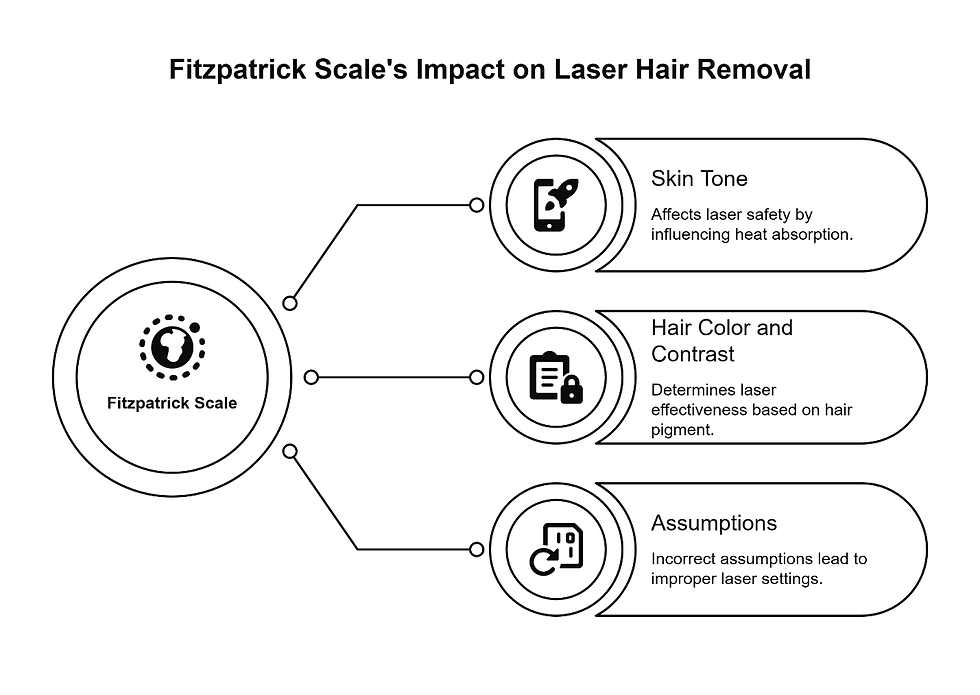
Traditional laser hair removal relies on the natural contrast between dark hair pigment and the surrounding skin to work safely. Because the laser's energy is drawn to dark pigment, a lack of contrast—or using the wrong energy settings—can cause the skin's surface to absorb the heat instead of the hair follicle, potentially damaging the surrounding tissues. This can result from using the wrong type of laser or suboptimal settings, leading to unwanted side effects, including burns, hypopigmentation, and scarring. A skilled provider adjusts energy levels, pulse duration, and cooling settings to protect your skin while still treating the hair effectively.
Modern laser systems, like those used at Avere Beauty, can safely treat a broad range of skin types. The key is matching the technology to your needs.
Why Hair Color and Contrast Still Matter
The Fitzpatrick Scale measures skin response, but laser effectiveness also depends on hair characteristics. Dark, coarse hair on lighter skin creates the highest contrast and typically responds fastest to treatment. Dark hair on dark skin requires different wavelengths and careful calibration—but it absolutely can be treated safely with the right equipment. Light or fine hair on any skin tone can be more challenging, though advances in laser technology continue to expand what's possible.
Why the Wrong Assumptions Create Poor Fit or Higher Risk
When someone tries to treat everyone the same way, problems happen. A provider who doesn't assess your skin type properly might use settings that are too aggressive for your melanin level or too weak for your hair type. Either scenario leads to frustration: burns and discoloration on one hand, wasted sessions and poor results on the other. The solution isn't avoiding laser treatment—it's finding a provider who takes assessment seriously.
A lot of first-time anxiety comes from hearing oversimplified advice online. Some people are told laser is "perfect for everyone." Others are told it's "not for darker skin." Neither message is helpful. The more accurate view is this: laser hair removal is about matching technology, settings, and timing to the individual in front of you. The Fitzpatrick Scale helps start that conversation, but it should never end it.
Why the Fitzpatrick Scale Is Helpful—But Not Enough on Its Own
Your self-assessment gets you halfway there. A professional consultation covers the rest. Here's where many readers feel relief: you don't need to solve the science on your own before you walk in. You only need enough clarity to ask better questions.
What a Consultation Checks That a Mirror Cannot
Before treatment, the area to be treated will be cleansed. But before that happens, your provider evaluates factors you can't see: the density of your hair follicles, any underlying skin conditions, how your skin has responded to previous treatments, and whether certain medications might affect healing. At Avere Beauty, this evaluation results in what they call a custom care plan—a personalized chart that tracks your visits and helps you visualize progress.
How Recent Sun Exposure, Medications, and Hair Characteristics Affect Candidacy
Had a beach vacation last week? Your consultation should be rescheduled. Sun-exposed skin is temporarily more sensitive to laser energy, and treating it increases the risk of hyperpigmentation. Taking certain antibiotics or retinoids? Your provider needs to know, as some medications increase photosensitivity. And while Fitzpatrick typing gives a general framework, your actual candidacy depends on examining all these variables together. Results are variable—Avere's team is honest about that—and the safest approach is always a thorough assessment.
That's why "What type am I?" is a smart first question, but "What is safest for me right now?" is the better one.
What to Expect at a Professional Consultation in Pittsburgh
Walking into a consultation shouldn't feel intimidating. If anything, it's the moment where uncertainty transforms into clarity.
How Avere Frames Personalized Care
Avere Beauty's approach starts with listening. A staff member will ask about your goals, examine the areas you want treated, and discuss what realistic outcomes look like. You'll learn which laser technology is best suited for your skin type—they use advanced systems capable of treating all skin tones—and get a clear timeline for sessions. One reviewer shared that their first laser hair removal experience was "super easy and not nearly as uncomfortable as expected," while another noted that the staff made them "feel comfortable during laser treatments" and was "patient with all my questions."
The consultation is free, which removes any pressure to commit before you're ready. You may also find it helpful to review What to Expect from Your Medspa before your appointment so the process feels more familiar.
Questions to Bring With You
Come prepared. Here are a few smart questions to ask before moving forward:
Based on my skin's sun response, what should I know before treatment?
Does my recent sun exposure change the timing?
How do my hair color and skin contrast affect planning?
What should I expect in terms of comfort, scheduling, and aftercare?
Are there any reasons I should wait or adjust the plan?
A good provider welcomes questions—it shows you're invested in your own results. Following both the before-treatment instructions and after-treatment instructions will greatly reduce your risk of side effects.
Your Safest Next Step
The Fitzpatrick Scale gives you vocabulary for a conversation you're ready to have. You now understand why your skin's sun response matters, how melanin affects treatment planning, and why a professional assessment goes beyond what any self-check can provide.
Use Your Self-Check to Start the Conversation
Think back to those beach-day questions. If you burn easily and rarely tan, mention that. If your skin adapts quickly to sun without burning, say so. Your observations give your provider a starting point, and they'll refine the picture from there.
Book a Free Consultation if You Want a Personalized Answer
The surest way to know whether laser hair removal is right for you—and how to do it safely—is to ask someone who can assess your skin in person. Avere Beauty offers free consultations at their Pittsburgh locations. Book Your Free Consultation to move from guessing to clarity.
You've spent enough time wondering. Now you have the information to move forward with confidence.
Disclaimer: This article is for educational purposes only and is not medical advice. Laser hair removal suitability depends on factors such as your skin history, hair characteristics, medications, sun exposure, and provider assessment. The safest way to determine the right treatment approach is through a professional consultation.
Our Editorial Process:
Our expert team uses AI tools to help organize and structure our initial drafts. Every piece is then extensively rewritten, fact-checked, and enriched with first-hand insights and experiences by expert humans on our Insights Team to ensure accuracy and clarity.
About the Avere Beauty Insights Team:
The Avere Beauty Insights Team is our dedicated engine for synthesizing complex topics into clear, helpful guides. While our content is thoroughly reviewed for clarity and accuracy, it is for informational purposes and should not replace professional advice.


Comments